
Most people think of charts, spreadsheets, and performance reports when hearing the term KPI, which can get overwhelming. But as Graham Kenny explains, KPIs are not just numbers, they are measures of relationships between a company and its stakeholders.
KPIs should demonstrate the value created in a two-way exchange. Businesses depend on employees, customers, suppliers, and investors in order to operate. Each of these groups expects something from the organization, and the organization expects something in return. Effective KPIs measure both sides of that exchange.
For example, a company can track employee engagement, but that number isn’t the end of it all. Engaged employees are more productive, more innovative, and provide better service to customers. That improved customer experience can lead to stronger brand image, repeat purchases, and ultimately financial growth. KPIs, therefore, should not be viewed as isolated statistics, but as connected indicators that influence one another over time.
KPIs as Predictors, Not Just Reports
Another insight from Kenny’s work is that KPIs should also be predictive. Many organizations use KPIs to look backwards instead of using it as leading indicators, as a predictor.
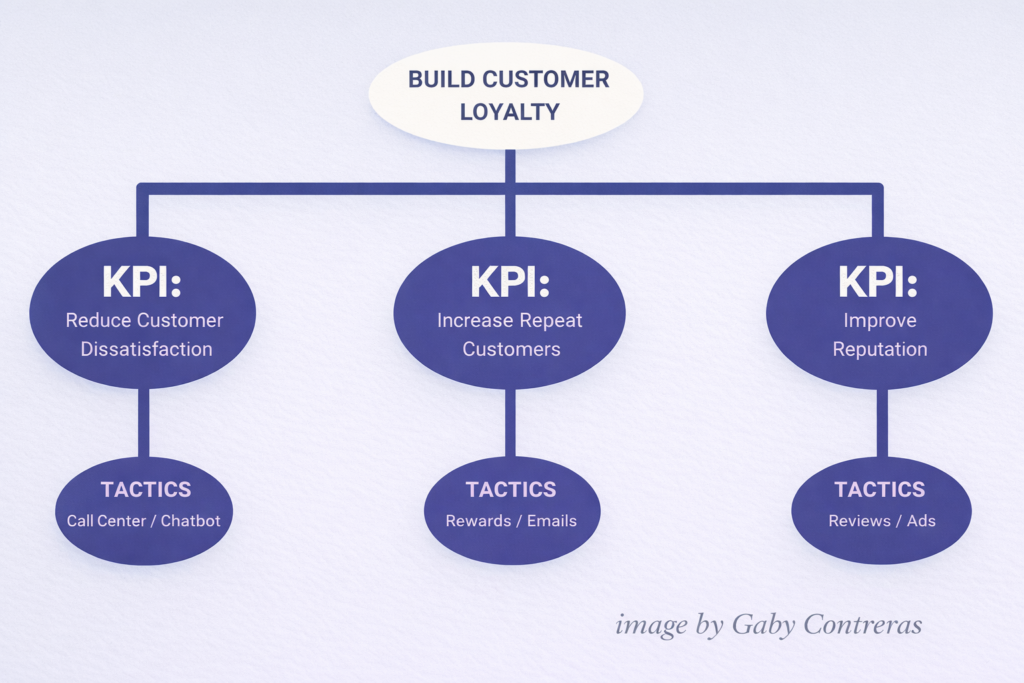
The diagram provided shows this clearly. The ultimate goal is to build customer loyalty, but that outcome is influenced by multiple interconnected KPIs:
- Reducing customer dissatisfaction
- Increasing repeat customers
- Improving brand reputation
Each of these KPIs is supported by specific tactics. When mapped together, these measures form a cause-and-effect chain which can lead to long-term loyalty.
KPIs Must Evolve
Because markets, customer expectations, and technology are constantly changing, KPIs organizations use must also adapt. What mattered last year may not be the strongest predictor of success this year.
In the end, KPIs work best when they are not used as accounting tools, but as a system that connects daily actions to long-term success.